
How to hold your pen or pencil more comfortably
Most of us are taught one conventional way to hold a pen: between the thumb and index finger, resting on the middle finger. It works for many people, but it is not the only way to write.
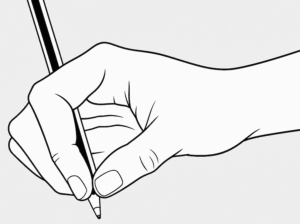 Taylor Swift uses a different grip. She holds pens between her index and middle fingers, creating a broader, more stable base. Japanese handwriting researcher Professor Hideki Oshiki has similarly argued that a good grip should be judged by comfort, control, appropriate pressure, legibility, and reduced fatigue, rather than whether it resembles a schoolbook diagram (Oshiki et al., 2003; Stead, 2022).
If your hand becomes tense, sore, or tired when writing, this small change may make a surprisingly large difference. Instead of resting the pen only on the middle finger, let it sit more securely between the index and middle fingers. The thumb and index finger still guide the pen, but you may need less squeezing to keep it stable.
There is no single perfect grip. The best one is the grip that helps you write clearly, comfortably, and with the least unnecessary effort.
Taylor Swift and the unconventional pen grip
The title of this article refers to Taylor Swift because she has repeatedly been photographed and filmed holding pens and pencils between her index and middle fingers (see here). The same grip is visible in the writing scene from the “Anti Hero” video and in photographs across different periods of her career (Stead, 2022). It is therefore reasonable to say that this is a habitual writing grip for Swift, not simply an accidental hand position (as you can see here).
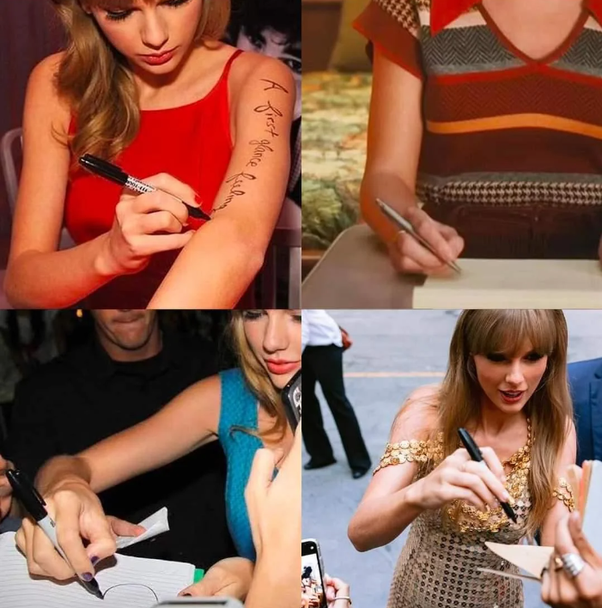
It may look unusual because it differs from the conventional school taught tripod grip. Yet occupational therapists quoted in reporting on the grip described it as an adapted or adaptive tripod grasp: a functional alternative, rather than a mistake that necessarily needs correcting. The wider point of contact may provide additional stability and may be useful for people whose finger joints are highly mobile or who find the ordinary tripod grip unstable (Stead, 2022).
Swift’s use of this grip does not prove that it is medically superior, prevent pain, or explain her songwriting. Nor should celebrity examples be substituted for research (she was voted 100 most influential people by Time Magazine). Its value here is simpler: it makes visible a functional grip that many people have never been taught. The appropriate question is whether the grip improves your own comfort, control, endurance, and legibility.
Anne Frank and an unconventional pen grip
The well known photograph of Anne Frank writing at a desk appears to show her holding the pen in a similar position, supported between or against the index and middle fingers. This is visually consistent with the adapted tripod grip described in this article. The photograph provides visual evidence of the position in that moment, although it cannot establish that she used this exact grip in every writing situation. See here: https://www.independent.co.uk/news/the-things-that-anne-was-really-frank-about-1359567.htm
That does not prove that Anne Frank always used this grip, nor does it show whether she found it more comfortable than another method. It does show that this kind of pen position is not a modern novelty or an obvious mistake. Together with Taylor Swift’s contemporary example, the photograph is a useful reminder that effective writing can emerge from grips that do not resemble a standard schoolbook diagram. The point is not that a particular grip makes someone a better writer. It is that a grip deserves to be taken seriously when it gives the writer stable control, clear writing, and less unnecessary tension.
Why change the way you hold a pen?
A familiar grip is not always an efficient one. Many people write by pinching the pen firmly between the thumb and index finger while using the middle finger as a narrow support. This can work well, but it may also encourage unnecessary tension during long periods of note taking, studying, journalling, drawing, completing forms, or writing at work.
You may recognise some of these patterns:
- You squeeze the pen tightly without meaning to
- Your fingertips become sore, pale, or tired
- Your thumb crosses over the pen or presses heavily against the index finger
- Your thumb joint bends backwards while writing
- You develop a pressure mark or callus on the middle finger
- Your wrist becomes stiff or bends sharply
- Your handwriting becomes more tense or less controlled as you continue
- Your hand aches after writing for a relatively short time
These signs do not necessarily mean that your grip is wrong. They may mean that your current way of holding the pen asks your hand to use more force than it needs. A different support point can sometimes reduce that effort.
The alternative: support the pen between the index and middle fingers
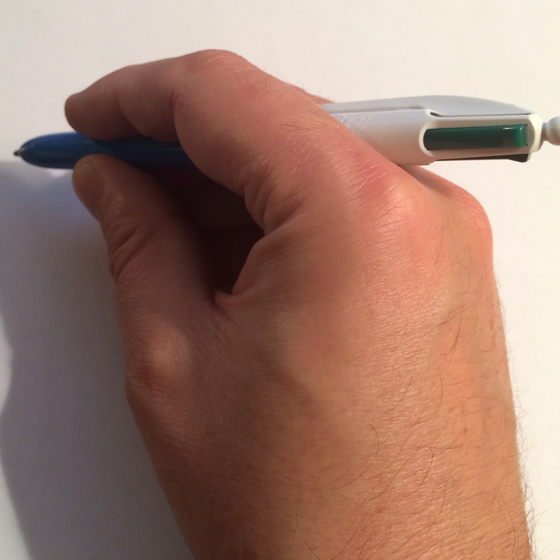
The grip described in this article is often called an adapted tripod grip, an adaptive tripod grip, or an interdigital brace grip. It is not a completely different way of writing. You still guide the pen with the thumb and index finger. The important difference is that the pen rests more securely in the space between the index and middle fingers, rather than relying only on the upper surface of the middle finger for support.
This gives the pen a wider channel in the hand. Instead of the thumb and index finger having to clamp the pen in place, the middle finger and the space beside it can help stabilise the barrel. The thumb and index finger can then guide the pen lightly and precisely. For some writers, this can make the pen feel more stable with less squeezing.
Why this grip may feel more ergonomic
Ergonomics does not mean that there is one ideal posture for every person. It means arranging an activity and tool so that they fit the person using them as well as reasonably possible. For handwriting, this includes the hand, fingers, wrist, forearm, posture, writing surface, pen, paper, writing task, and length of time spent writing.
The adapted tripod grip may be more ergonomic for some people because it can:
- Create a broader and more stable support point for the pen
- Reduce the urge to pinch tightly between the thumb and index finger
- Share the task of stabilising the pen across more of the hand
- Allow the thumb and index finger to guide rather than clamp
- Make it easier to use lighter pressure on the page
- Reduce local pressure on the side of the middle finger
- Encourage smoother movement across the page
- Make the grip feel less effortful during longer writing sessions
These are possible benefits, not guarantees. A grip that helps one person may feel awkward or unhelpful to another. The useful test is practical: does the grip make your writing clearer, more comfortable, and less tiring? Although initially it will feel different or strange, that’s the power of habits. Read about my experience further down this blog.
How to try the adapted tripod grip
Do not force your hand into a rigid shape. Use these instructions as a starting point, then make small adjustments until the pen feels stable and comfortable.
- Hold the pen in your usual writing hand.
- Place the barrel so that it rests in the space between the index and middle fingers.
- Allow the middle finger to support the pen from beneath or beside it.
- Rest the thumb lightly on the barrel.
- Allow the index finger to guide the pen from above or slightly to the side.
- Keep the web space between the thumb and index finger reasonably open rather than collapsing the thumb tightly into the hand.
- Hold the pen firmly enough to control it, but lightly enough that your fingertips do not tense or whiten.
- Let the pen point naturally back towards the shoulder on the same side as your writing hand.
- Write several short lines and notice whether the hand feels more stable, less pinched, or more relaxed.
The grip may initially feel unfamiliar. That is normal. A long established movement pattern can feel strange even when it is more comfortable. Try it for a few minutes at a time before deciding whether it suits you.
A quick comparison
| Conventional tripod grip | Adapted tripod grip |
| Pen commonly rests on the middle finger | Pen rests more securely between the index and middle fingers |
| Thumb and index finger may take most of the stabilising force | Support is spread more broadly through the index and middle fingers |
| Can be comfortable and effective for many people | Can be a useful alternative where the conventional grip feels tight or unstable |
| May encourage excessive pinching in some writers | May reduce the urge to pinch for some writers |
| Commonly shown in school handwriting diagrams | Less commonly taught, despite being a functional alternative |
Neither approach is automatically better. The adapted grip is useful because it gives people another option, particularly when the conventional version is effortful or uncomfortable.
Professor Hideki Oshiki and the idea of a “desirable” grip
Professor Hideki Oshiki is a Japanese scholar of handwriting education at Joetsu University of Education in Niigata. His research examines handwriting as both a learned skill and a physical action, including pen holding, writing posture, pen pressure, stroke order, letter form, and the movements involved in writing by hand (Oshiki et al., 2003).
Oshiki’s work moves beyond the simplistic question, “Is this the correct grip?” Instead, he and his colleagues proposed that a desirable pen grip should be judged by whether it enables effective writing. In practical terms, a useful grip should allow the writer to control the pen angle; use an appropriate amount of grip force and pen pressure; move the pen smoothly; see the writing tip clearly; keep the pen stable; write legibly and at a practical speed; and avoid unnecessary fatigue (Oshiki et al., 2003).
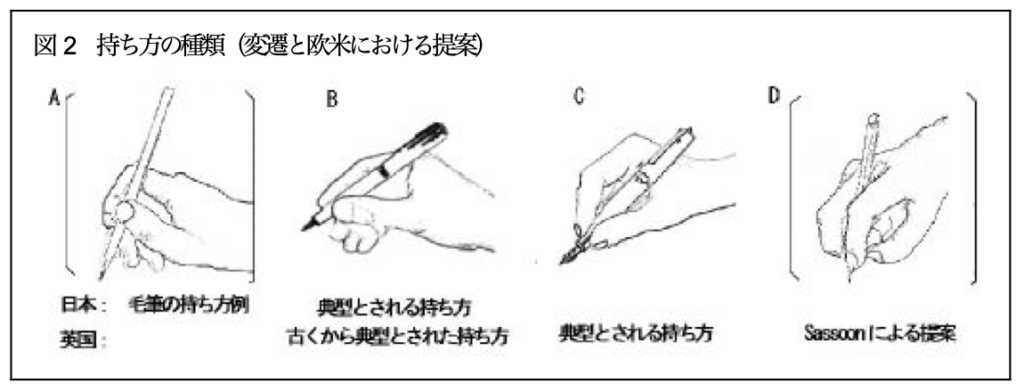
Pen grip D is the one this blog is about.
In a small observational survey of 50 university students, Oshiki reported that none used the conventionally prescribed school grip. This does not mean that none could write well. It suggests that people often develop ways of holding a pen that differ from formal textbook diagrams. The central issue is therefore what a grip enables a writer to do, rather than whether it resembles a schoolbook illustration (Oshiki, 2002).
An older tradition of holding a writing tool
Supporting a writing tool with the thumb, index finger, and middle finger is not as unusual as it may appear. In Japanese calligraphy, or shodō, traditional brush holding methods include sōkōhō, sometimes translated as the “double hook” method. This uses the thumb, index finger, and middle finger to control the brush, while the ring and little fingers provide support (Ministry of Foreign Affairs of Japan, n.d.).
This is not identical to the adapted pen grip. A calligraphy brush is normally held more upright, moved more from the arm, and responds differently to pressure. However, the principle is similar: the tool is supported by a coordinated relationship between the thumb, index finger, and middle finger, rather than by a rigid pinch alone.
Japanese brush traditions therefore show that there has never been only one legitimate way to hold a writing or drawing tool. They do not prove that this grip is universally best for modern handwriting, but they offer useful historical context for an alternative that may feel more stable and comfortable for some writers (Ministry of Foreign Affairs of Japan, n.d.).
Handwriting, learning, and attention
The way you hold a pen does not determine intelligence, reading ability, or how much someone can learn. Many people use unconventional but entirely effective grips. However, when handwriting is slow, painful, tiring, or difficult to control, the physical act of producing letters can take attention away from spelling, note taking, organising ideas, and responding to what is being taught. A systematic review of 17 studies involving 3,343 kindergarten children found that letter writing fluency was associated with writing composition, letter name and sound knowledge, spelling, and word reading. This does not show that a particular pen grip creates better readers. Rather, it suggests that increasingly fluent and automatic handwriting can support wider literacy learning, especially in the early years. A grip is therefore worth adapting when it genuinely improves comfort, control, endurance, legibility, or writing speed, not merely because it looks unusual (Ray et al., 2022; Schwellnus et al., 2013).
A small change can matter
Handwriting is made up of many repeated movements. When you write notes in a meeting, revise for an examination, complete a journal entry, sign documents, annotate a book, or write a letter, your hand may repeat the same gripping action hundreds or thousands of times. A small reduction in unnecessary gripping force can therefore become meaningful over a longer writing session.
This does not mean that the adapted tripod grip will eliminate pain or solve every writing difficulty. Writing discomfort can also be affected by posture, desk height, pen size, paper angle, ink flow, joint mobility, handwriting speed, stress on the hand, and underlying health conditions. However, because this grip changes the pen’s support point, it is worth trying properly before dismissing it as unconventional.
Use less pressure than you think
The grip itself is only part of the story. Many people use far more pressure than is necessary to write clearly. Try this simple exercise:
1. Write one sentence normally.
2. Notice the pressure in your thumb, index finger, middle finger, and wrist.
3. Write the same sentence again while holding the pen slightly more lightly.
4. Keep reducing pressure until the ink begins to become faint.
5. Increase the pressure only enough to make the writing clear.
The aim is not to let the pen wobble or produce illegible writing. It is to find the least amount of force that still gives you control and a readable result. A pen that flows smoothly may help. If you have to press hard to make the ink appear, try a different pen before assuming that your hand is the problem.
Choose a pen that helps rather than hinders
The pen itself affects comfort more than many people realise. A very thin, slippery, scratchy, or poorly flowing pen can make you grip harder. A pen that is too heavy can also tire the hand, while one that is too light may feel unstable for some people.
Experiment with:
- A slightly thicker barrel if you grip narrow pens tightly
- A soft or textured grip if it improves control without feeling bulky
- Smooth flowing ink that does not require heavy pressure
- A lighter or heavier pen, depending on which feels more stable
- A triangular pen barrel or pencil grip if it gives your fingers a comfortable place to rest
- A pencil with an appropriate hardness for the paper you use
There is no universal best pen. The most suitable writing tool is the one that lets you write clearly and comfortably with the least unnecessary effort.
Position the paper and support the arm
Even an excellent grip can become tiring if the wrist, arm, or shoulders are held awkwardly. A more comfortable writing position usually includes:
- Both feet supported on the floor or a stable footrest
- A chair and desk height that allow the shoulders to remain relaxed
- Forearms resting lightly on the desk where possible
- Enough room to move the writing arm without raising the shoulder
- Paper positioned so that you can see the writing without twisting your neck
- A paper angle that allows the wrist to remain reasonably relaxed
For many right handed writers, turning the paper slightly clockwise can help the wrist remain more neutral. For many left handed writers, a slight anticlockwise angle can be helpful. These are only starting points. Adjust the paper until your hand, wrist, and shoulder feel free rather than fixed. NHS occupational therapy guidance likewise highlights stable sitting, supported feet, comfortable positioning, and thoughtful paper placement as practical aspects of handwriting support (West Suffolk NHS Foundation Trust, n.d.).
Who may find this alternative grip helpful?
The adapted tripod grip may be especially worth trying if you:
- Hold a pen tightly enough to make the fingertips sore
- Feel pressure between the thumb and index finger
- Cross the thumb over the pen or around the index finger
- Notice the thumb joint bending backwards while writing
- Have a painful mark or callus on the middle finger
- Find a conventional tripod grip unstable
- Have highly mobile finger joints
- Write with excessive pressure on the page
- Experience hand fatigue during extended note taking
- Find that the wrist becomes stiff during writing
- Have already tried changing pens but still feel that the pen is difficult to control comfortably
It may also be useful for artists, students, writers, researchers, musicians making annotations, and anyone who writes for sustained periods.
Do not change a grip that already works
You do not need to change your grip simply because it looks different from a textbook illustration. Research has identified several mature and functional grasp patterns. In a study of Grade 4 children, common dynamic and lateral tripod and quadrupod patterns did not show a general difference in handwriting speed or legibility following a sustained copying task (Schwellnus et al., 2013).
If you can write clearly, comfortably, and at the speed you need, with no pain or significant fatigue, your current grip is probably serving you well. This article is for people who feel that their grip is tight, effortful, unstable, painful, or tiring, and who would like another option to test. The adapted tripod is not a rule. It is an invitation to experiment.
How to test whether it works for you
Test the grip over several short writing sessions rather than making a judgement after one minute. Use the same pen, paper, and task where possible. For example, write the same paragraph using your usual grip and the adapted grip.
After each trial, consider:
- Which grip required less squeezing?
- Which grip felt more stable?
- Which grip made the pen easier to control?
- Which grip produced clearer writing?
- Which grip allowed you to write at a comfortable speed?
- Which grip caused less pressure in the thumb, index finger, middle finger, wrist, or forearm?
- Which grip felt better after five or ten minutes?
Keep the approach that genuinely improves your experience. If the adapted grip feels better at first but makes writing less legible or requires more effort after several minutes, adjust it or return to your usual grip. The purpose is not to follow a method rigidly. The purpose is to write more comfortably and effectively.
Take breaks during longer writing sessions
Even a comfortable grip becomes tiring when held for too long. During extended handwriting tasks, take short, regular pauses. Let the hand open and close gently, move the fingers, lower the shoulders, and change your posture. Avoid waiting until the hand is already painful before taking a break. Short pauses can help prevent a build up of unnecessary muscular tension, particularly during intensive study, long meetings, examination preparation, or detailed creative work.
When discomfort needs professional advice
A new grip may help ordinary writing fatigue, but it is not a substitute for assessment where symptoms are persistent or significant. Seek appropriate advice from a GP, physiotherapist, occupational therapist, or hand therapist if you experience:
- Persistent or worsening hand pain
- Numbness or tingling
- Weakness or reduced grip strength
- Swelling
- Pain that continues after writing has stopped
- Repeated cramping or loss of hand control
- Pain affecting daily activities beyond handwriting
The NHS advises seeking medical guidance for persistent or significant hand pain (NHS, 2022).
My experience: an unfamiliar grip can become natural
At first, this grip may feel strange. That is unsurprising: handwriting is a highly practised motor habit, and even a small change in finger position can feel awkward at the beginning.
In my experience, consistent use for roughly three weeks was enough for the grip to begin feeling natural and normal, and definitely better, lighter and easier (except if you’re writing with a thick marker). Eventually, returning to the previous way of holding the pen felt more unfamiliar and more tense than the new position. This should be understood as a personal observation, not a universal timetable. There is no reliable evidence that every person requires about 21 days to adapt to a new grip or habit.
The practical approach is to test it gently and consistently. Use the grip for short writing tasks at first, then gradually use it for longer periods if it continues to feel more stable and comfortable. Do not persist through pain, numbness, or worsening discomfort.
The key point
Most people are shown only one way to hold a pen. The adapted tripod grip offers another possibility. By allowing the pen to rest more securely between the index and middle fingers, it may give some writers a broader, more stable support point and reduce the need to pinch tightly.
It will not be the best grip for everybody. But if your usual grip feels tense, tiring, or unstable, it may be one of the simplest changes you can try. Hold the pen lightly. Support it well. Let the fingers guide rather than clamp. Keep the wrist and forearm comfortable. Use a pen that works with your hand rather than against it.
The best pen grip is not necessarily the one that looks most traditional. It is the one that helps you write clearly, comfortably, and with the least unnecessary effort.
References
NHS. (2022). Hand pain. https://www.nhs.uk/symptoms/hand-pain/
Oshiki, H. (2002). 筆記具の持ち方と姿勢 [How to hold writing implements and posture]. Joetsu University of Education. http://www.shosha.kokugo.juen.ac.jp/oshiki/graphono/mochikata/mochi.htm
Oshiki, H., Kondo, S., & Hashimoto, A. (2003). 望ましい筆記具の持ち方とその合理性および検証方法について[Desirable ways of holding writing implements: Their rationale and methods of verification] [PDF]. 書写書道教育研究, 17, 11–20. 上越教育大学. https://doi.org/10.82787/jacse.17.0_11
http://www.shosha.kokugo.juen.ac.jp/oshiki/ronbun/2003_mochikata_paper/2003_oshiki_mochikatariron.pdf
Ray, K., Dally, K., Rowlandson, L., Tam, K. I., & Lane, A. E. (2022). The relationship of handwriting ability and literacy in kindergarten: A systematic review. Reading and Writing, 35, 1119–1155. https://doi.org/10.1007/s11145-021-10224-8
Schwellnus, H., Carnahan, H., Kushki, A., Polatajko, H., Missiuna, C., & Chau, T. (2013). Writing forces associated with four pencil grasp patterns in Grade 4 children. American Journal of Occupational Therapy, 67(2), 218–227. https://doi.org/10.5014/ajot.2013.005538
Stead, M. (2022, October 24). Why does Taylor Swift hold her pen like that? Is she OK? Slate. https://slate.com/culture/2022/10/taylor-swift-midnights-anti-hero-video-pen-photos.html
West Suffolk NHS Foundation Trust. (n.d.). Hand writing advice: Top tips [Patient information leaflet]. https://www.wsh.nhs.uk/CMS-Documents/Patient-leaflets/OccupationalTherapy/6312-1-Hand-writing-advice-top-tips.pdf
Research note
The evidence base has limitations. Much grip research involves children, limited samples, and relatively short writing tasks. There is no high quality evidence that one grip is universally superior. The most meaningful test is whether an adjustment improves comfort, control, endurance, and legibility for the individual writer. Public examples, including Taylor Swift and the photograph of Anne Frank, illustrate that the grip can be functional; they are not scientific evidence of clinical superiority.