
Flatland: Summary, Characters, Plot and Themes
Edwin Abbott Abbott’s strange, witty novella about geometry, social hierarchy, censorship, and the boundaries of human imagination.
Flatland: A Romance of Many Dimensions is a short 1884 satirical novella by Edwin Abbott Abbott. On the surface, it is a fanciful story about a two-dimensional universe populated by geometric shapes. Underneath, it is a forceful critique of rigid class systems, sexism, authoritarian power, and the human tendency to reject ideas that challenge familiar beliefs.
“The one who can only see what is before him is not likely to see what lies beyond.”
FULL TITLE Flatland: A Romance of Many Dimensions
AUTHOR Edwin Abbott Abbott
FIRST PUBLISHED 1884
FORM Satirical novella; mathematical and philosophical allegory
LENGTH About 33,000 words; often 90–120 pages, depending on the edition
NARRATOR A Square, who also presents himself as the book’s author
SETTING Flatland, a two-dimensional world inhabited by geometric figures
AVAILABILITY Public domain; the full text is freely available from Project Gutenberg.
The original title-page joke matters: Abbott frames the book as if it were written by “A Square,” not by Abbott himself. The original edition also includes illustrations, making readers work through the practical consequences of living in a world that has length and width but no height.
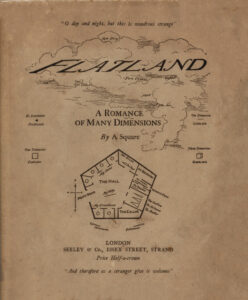
Original cover of Flatland
The world of Flatland
Flatland is a plane. Its people can move left, right, forward, and backward, but they cannot move above or below anything. They see other beings edge-on, so a whole polygon may look only like a line segment. Homes, doors, vision, recognition, and even social manners must therefore work very differently from life in a three-dimensional world.
Social status is determined by shape. In general, the more sides a male figure has, and the more regular those sides are, the higher his position in society. The social order presents itself as logical and natural, but the book shows how arbitrary and brutal it can be.
| FIGURES | POSITION IN FLATLAND SOCIETY |
| Women (line segments) | Denied equal status and treated by law as dangerous. Their treatment is one of the novella’s most disturbing satirical elements. |
| Isosceles triangles | Soldiers, laborers, and the lowest male class. Their sharpness and irregularity are associated with danger and inferiority. |
| Equilateral triangles and squares | Respectable middle and professional classes. A Square belongs here. |
| Polygons with many sides | Upper-class figures whose increasing regularity gives them greater prestige. |
| Circles | The priestly and governing elite. They guard Flatland’s official beliefs and social hierarchy. |
Main characters
| CHARACTER | WHO THEY ARE | WHY THEY MATTER |
| A Square | The narrator and protagonist, a respectable middle-class polygon. | He begins as a conventional believer in Flatland’s order, then becomes a radical outsider after seeing a higher dimension. |
| The Sphere | A visitor from Spaceland, a three-dimensional world. | He reveals the existence of the third dimension and becomes the catalyst for A Square’s intellectual transformation. |
| The Monarch of Lineland | Ruler of a one-dimensional world. | His inability to understand two dimensions mirrors A Square’s early inability to imagine three dimensions. |
| A Square’s wife | A line segment and A Square’s spouse. | Her position demonstrates Flatland’s sexist laws and assumptions. |
| A Square’s grandson | A young hexagon. | He helps establish A Square’s comfortable family life before it is disrupted by revelation and persecution. |
| The Circles | Flatland’s priestly rulers. | They represent institutional power, intellectual control, and the suppression of inconvenient knowledge. |
Full plot summary
Part I: A rigid two-dimensional society
A Square introduces the reader to Flatland, a world with only two dimensions. He explains its physical rules and its strict social hierarchy. Since people cannot see one another’s complete forms, they identify shapes through movement, touch, sound, and special techniques such as using fog to distinguish angles. What initially sounds like a clever thought experiment gradually becomes a grim portrait of an unequal society.
Flatland’s rulers insist that its hierarchy is rational. Yet its laws confine women, control lower-class triangles, and punish deviations from social norms. A Square initially accepts much of this system. He is intelligent, educated, and curious, but he is not yet free from the prejudices of his own world.
“Alas, a few years ago, I should have said ‘my universe:’ but now my mind has been opened to higher views of things.”
A dream of Lineland
On the eve of a new millennium, A Square dreams that he visits Lineland, a one-dimensional universe. Lineland’s inhabitants are line segments that can move only in two directions along a single line. Their king, the Monarch, cannot understand what A Square means when he claims there is another direction outside the line.
To the Monarch, A Square’s claims are nonsense. He can only perceive A Square as a changing point or line segment, not as a complete two-dimensional being. A Square is frustrated by the Monarch’s narrowness, without recognizing that he himself is about to face a similar challenge.
“I call our world Flatland, not because we call it so, but to make its nature clearer to you, my happy readers, who are privileged to live in Space.”
The arrival of the Sphere
The next day, a Sphere from Spaceland appears in A Square’s home. The event seems impossible: a circle appears apparently from nowhere, becomes larger, then smaller, and disappears. In fact, A Square is seeing the changing cross-section of a three-dimensional sphere passing through the two-dimensional plane of Flatland.
The Sphere tries to explain the third dimension through argument, but A Square cannot initially understand. Finally, the Sphere lifts A Square out of Flatland and into Spaceland. From above, A Square sees his world in a completely new way: he can look into houses, see through walls, and view the interiors of figures whose bodies had previously seemed closed and unknowable.
“I am not a stranger, but a higher kind of being.”
Revelation, doubt and imprisonment
A Square finally accepts that Spaceland exists. But his new understanding immediately carries him further: he asks whether there could be a fourth dimension beyond Spaceland. The Sphere, who demanded that A Square open his mind, refuses to consider this possibility. The Sphere’s reaction shows that even an enlightened teacher may have limits to his imagination.
When A Square returns to Flatland, he tries to tell others what he has learned. The ruling authorities consider the idea of a third dimension dangerous. Rather than debate it honestly, they imprison him for life. The novel is presented as A Square’s account from prison, written in hope that future generations may become more open to truths their society currently refuses to acknowledge.
“You say you see a plane, and that a plane has length and breadth. I see only length. You are not a stranger, but a madman.”
Major themes and ideas
Perception and higher dimensions
The novel turns an abstract mathematical question into a vivid narrative. A one-dimensional being cannot easily understand a second dimension; a two-dimensional being cannot easily understand a third. The reader is invited to consider whether human beings might also be limited by the boundaries of their senses and assumptions.
“What you call a Sphere is merely a Circle.”
LINELAND (1D) → FLATLAND (2D) → SPACELAND (3D) → POSSIBLE HIGHER DIMENSIONS
Class and inherited privilege
Flatland’s geometry-based caste system satirizes Victorian class hierarchy. The elite treat their advantages as evidence of inherent superiority, while the disadvantaged are controlled, feared, and excluded. Abbott exposes how easily an unjust social system can disguise itself as common sense.
“There is no such thing as a third dimension.”
“The very idea of a third dimension is ridiculous.”
Gender inequality
Women in Flatland are reduced to lines and subjected to extreme legal and social restrictions. The book’s presentation can be uncomfortable to read, but it lays bare the dehumanizing logic of a culture that treats women as threats rather than equals. Readers continue to debate how fully the novel critiques the sexist attitudes it depicts.
Censorship and political power
The Circles do not suppress A Square’s ideas because they have logically disproved them. They suppress them because the ideas threaten the authority and stability of the ruling order. The novella therefore connects intellectual freedom with political freedom.
“If I might but arouse the young and hopeful to aspire to higher and higher dimensions, I should not have lived in vain.”
The limits of certainty
A Square learns to accept the third dimension, but the Sphere refuses to consider a fourth. The point is not simply that higher dimensions may exist. It is that people at every level can mistake the limits of their own understanding for the limits of reality.
At its heart, Flatland asks a question that applies far beyond geometry: what might we fail to see because our world has taught us that it is impossible?
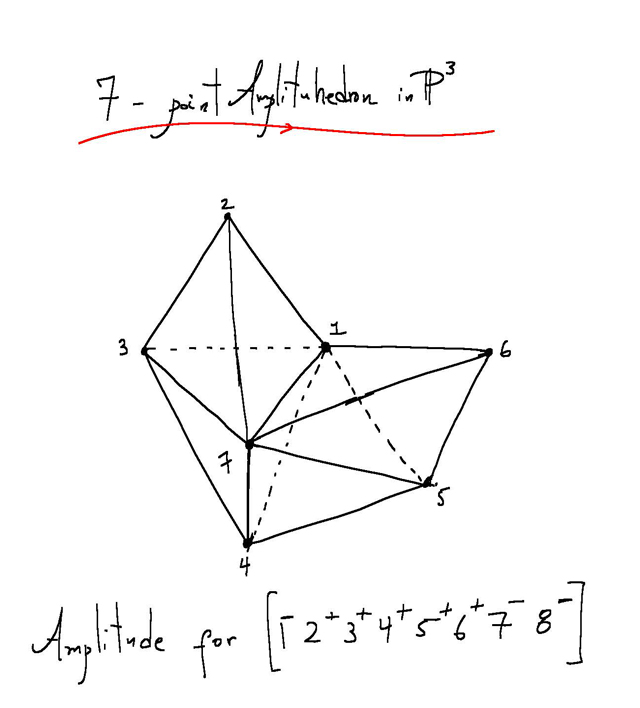
A sketch of the amplituhedron representing an 8-gluon particle interaction. Using Feynman diagrams, the same calculation would take roughly 500 pages of algebra.
From Flatland to the amplituhedron
Flatland remains a useful imaginative doorway into modern discussions of geometry, although Abbott’s fictional dimensions should not be confused with a direct account of contemporary physics. One striking modern example is the amplituhedron, a high-dimensional “positive geometry” introduced by physicists Nima Arkani-Hamed and Jaroslav Trnka in 2013 to describe particular particle-scattering calculations in planar N=4 supersymmetric Yang–Mills theory. In this specialised setting, the geometry can encode results usually expressed through much more elaborate spacetime-based calculations; it does not demonstrate that everyday objects are secretly Flatland-like, nor does it establish a spiritual claim about reality. Cognitive scientist Donald Hoffman, meanwhile, argues more speculatively that space, time, and physical objects may function as an evolved perceptual interface rather than a literal picture of ultimate reality. Taken carefully, these ideas echo the literary provocation of A Square’s encounter with the Sphere: a familiar world may be only one representation of something deeper. For a wider, explicitly philosophical exploration connecting positive geometry, consciousness, and environmental harmonisation, see “Feng Shui Beyond Time and Space: A Radical Reimagining of Environmental Harmonisation”.
“And, in a word, we are in a condition of utter and absolute ignorance of all that lies beyond the limits of our perception.”
Why the novella still matters
Flatland remains readable because it is both playful and serious. It can introduce readers to dimensional thinking, but it is not merely a mathematics puzzle. Its story of a person who discovers a truth, tries to share it, and is punished by a fearful establishment still speaks to questions about education, social prejudice, free inquiry, and institutional power.
This summary is based on the public-domain text of Flatland: A Romance of Many Dimensions. You can read the complete book for free at Project Gutenberg.
“May aspire yet higher and higher to the secrets of Four, Five or even Six Dimensions, thereby contributing to the enlargement of the imagination and the possible development of that most excellent gift of Modesty among the superior races of Solid Humanity.”